
|
Posted at 1:37 am on May 17, 2014, by Eric D. Dixon
Alexandria City Councillor Justin Wilson (no, unfortunately not that Justin Wilson) invited me to provide testimony for a food truck regulatory hearing, so here’s what I sent to him: Although I live just outside the city proper, in Fairfax County, Alexandria city is in many ways still my community. I shop at Giant, Whole Foods, and Trader Joe’s; I eat at Old Town restaurants and play trivia in Old Town bars; I watch plays at the Little Theater and watch movies at AMC Hoffman. Perhaps even more importantly, in two weeks my employer’s offices are moving from the Watergate to Duke Street, right at the edge of Old Town. I already spend a tremendous amount of time in Alexandria city, and I’ll soon be spending nearly all my days working here as well. There are a great many reasons to love Alexandria, but one thing this city is sorely lacking is a robust food truck culture. I have little doubt that existing brick-and-mortar restaurants aren’t excited at the prospect of competing with a horde of nimble upstarts who have lower overhead and fresh ideas. But competition breeds innovation, and food trucks both create and expand niche and otherwise underserved markets. An example close to my own heart can be found in my hometown: Portland, Ore. Only two years ago, a couple of paleo diet enthusiasts launched a modest Kickstarter for $5,000 to fund a food truck they planned to call Cultured Caveman. Now, regardless of what you think about paleo, there’s no question that this is a niche market. Dedicated paleo restaurants simply don’t exist — at least, they didn’t in 2012. But the Cultured Caveman folks found a groundswell of community support, easily surpassing their fundraising goal and expanding from one cart to three, spaced throughout town, in less than two years. Just this past March, they successfully exceeded a $30,000 Kickstarter campaign to open their first brick-and-mortar restaurant. There’s no way this couple of young, 20-something entrepreneurs could have gambled on a full restaurant right out of the gate, with no real capital, no experience as restaurant owners, and no idea whether they’d be able to attract a clientele with a menu so strictly limited in concept. But with a small level of overhead and a big dream, they parlayed a few thousand dollars into a citywide franchise that has made many thousands of Portlandians happy. People with celiac disease or lactose intolerance, people avoiding processed sugar and chemical additives, people who simply care about organic produce and grass-fed meat — they all now have a set of prepared-food options where they know that literally everything on the menu will meet their unique dietary restrictions. I don’t know whether Alexandria could be home to a success story of exactly this type, but my real point here is that nobody knows. We can’t know unless the political process steps out of the way of entrepreneurs who want to put their money at risk in order to bring the people of Alexandria new options. Let consumer preference reveal itself by lifting food truck restrictions and letting innovation flourish. Let us all find out which great untried ideas are out there that we’ll someday wonder how we ever lived without. [Cross-posted at The Shrubbloggers.] Filed under: Uncategorized Comments: 1 Comment
|

|
Posted at 7:05 pm on March 4, 2014, by Vroman
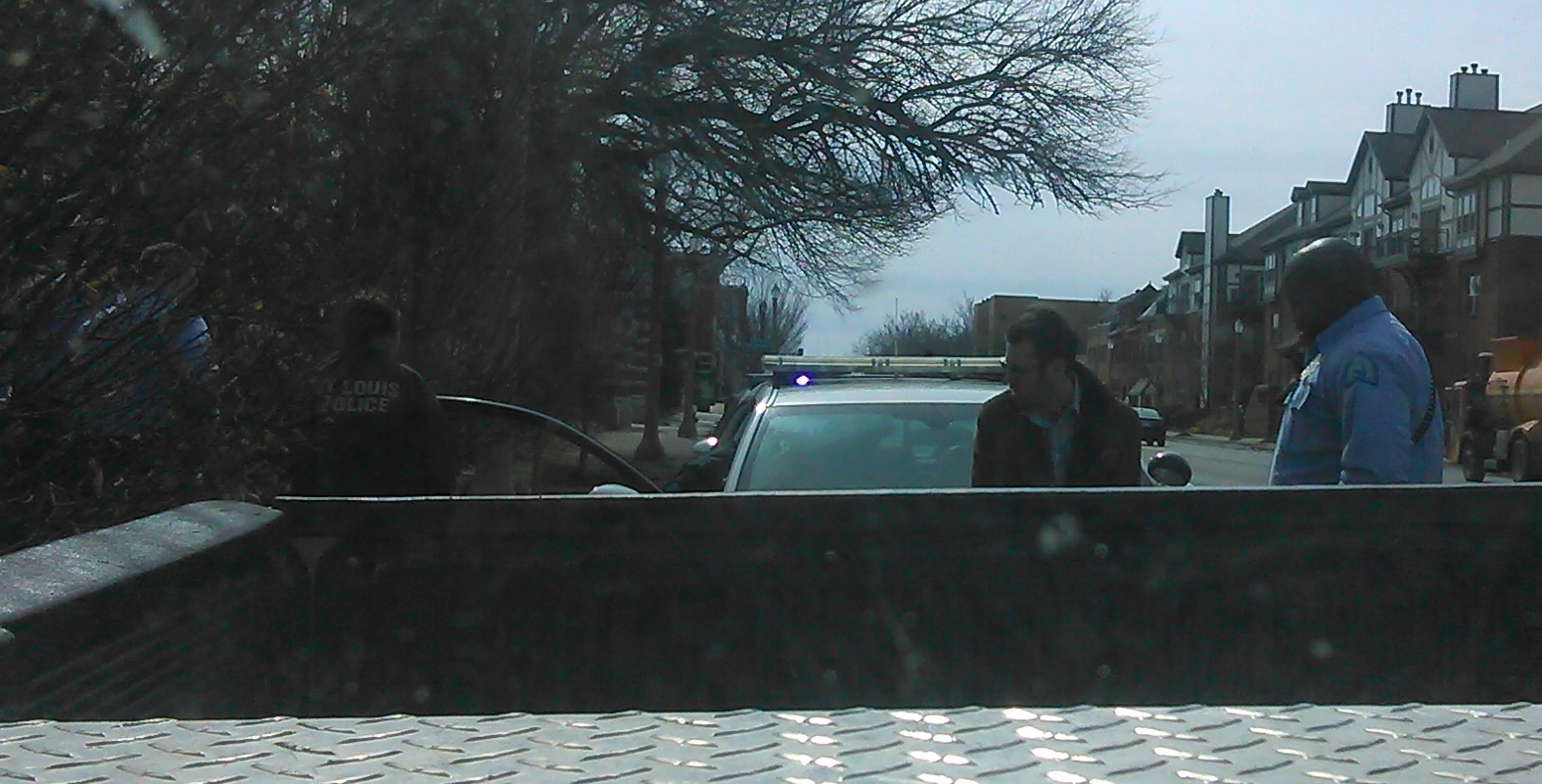
UPDATE: I discussed this incident as a podcast guest, starting at 1:04:00. I spent the two worst nights of my life in the St. Louis City Justice Center. I did not experience nor witness any physical violence, not even credible threats. What I got was plenty of apathetic incompetence, banal sadism, and agonizing obtuseness. The vast majority of people dragged through this institution are poor and black, though plenty were educated. Their complaints are evidently easily and frequently ignored. I hope to convince people outside that demographic the City Jail really is run absurdly poorly. I run a small real estate business specializing in North St. Louis City. This winter ravaged my bottom line. Repair costs are running five times over this time last year. I was quickly reduced to a 24 hour cash cycle, so when I got two traffic tickets in the city, and summons for unpaid vacancy code fine in Florissant, I was forced to choose between paying arbitrary fees to the government, or keeping my tenants homes operational. Many of these people are behind on their rent, yet when its 5 degrees out, I still fixed water heaters and roofs every time, with no breathing room left over for my own problems. Thats the decision I made, wise or not, which got me multiple warrants. I was finally pulled over noon Tuesday 2-18-14, at Grand and Shaw for expired plates. I was politely cooperative, immediately informed cop I have CCW and a pistol. My permission is not asked, but my vehicle is searched. He finds a google route map of every Bank of America in the city. I collect rent in cash in places like Fairground Park. I need to know the closest bank wherever I happen to be. A sergeant arrives and uses this very flimsy evidence to charge me as an “armed fugitive”. This seems pretty farfetched, so I am still mainly concerned about a wasted evening. My passenger was also arrested with no charges or warrants. An FBI agent arrives to interrogate me at 2nd District station, about what he has been told is a possible bank robbery conspiracy. I talk about my business 10 minutes and he leaves, and person riding with me is released. I hope the sergeant who felt it necessary to bring this matter to the Federal government’s attention is at least embarrassed. I wait in the 2nd Dist holding cell for several hours, with Lovelle Robinson, 26yo Benton Park resident, who by the end of this ordeal, I’d consider a friend. He’s trapped in a vicious cycle of fines he can’t afford which cost his license, and inevitable jail time, which costs his job, six times, and half his demographic is in this snare. What good is providing a transportation network for your citizens, but enforcing rules so draconian –allegedly for their safety– that they are pauperized out of using the system at all? The sergeant informs me he has graciously dropped the weapons charges and I am being shipped downtown for the traffic warrants. My gun is mailed to Jeff City for a ballistics tests. Allegedly I get it back in 4-6 weeks, assuming I haven’t shot anyone. 4p, we are handcuffed together en route to the Justice Center. We arrive on the loading dock of this monolithic cube, with 15′ ceilings, and are detail searched. Routine processing questions are answered. And now I am expecting some kind of briefing of what are my options and how long until the next step. Instead my questions are deferred to “later” and I am uncuffed and placed in one of four 10’x20’ cells, standing room only, with 25 other prisoners. The door is plexiglass, naturally lots of shouting, very difficult to hear guards. And the hours begin to pass. I am hearing from several different repeat visitors that we are waiting to go up “upstairs”, presumably to smaller cells. I am not hearing how and when you can pay money to get out of here. At 6pm we are given a dinner of single slice of bologna on two slices of bread and six very stale tortilla chips. By 8pm I was eager to make a deal. The atmosphere in the cell was convivial, but grumpy to the say the least. And yet still absolutely no communication of substance from anyone in authority. The blue shirts refer you to the burgundy shirts, who refer you to the white shirts, who say they don’t have your file. And you get one sentence in passing every ten minutes. Around 11pm we are marched en masse upstairs. And placed in an identical cell, on an identical laid out floor. Two hours pass. Its 1am and dawns on us, this is it, there are no bunks coming. The people who designed this system expect 25 adults to sleep shoulder to shoulder on the concrete floor of a 60degree, urine rank cattle car, regardless of what they came in here wearing, or committing. Some percentage of these people will be found not guilty. I have a leather coat, and resign myself to optimizing for some pathetic local maximum of comfort. I’ve got to choose between a terrible pillow, or a terrible blanket, nuzzled against total strangers stuck here against their will. I’m not fearful of them, but holy hell, doesn’t mean I’d invite them over to snuggle. Every 45-90 minutes prisoners are swapped for unclear reasons. Its impossible to relax, the anticipation of the next door opening, that my existence will be acknowledged, and I will be given a glimmer of an opportunity to bargain for release, or at least some kind of ETA. Ambient noise is extremely disruptive, even as most prisoners try to fall asleep. I am very hungry. I doze shallowly until about 4a. I sit up, look around at this tight row of poor wretches, and just jawdrop that this is a normal night here. Every single night our city makes 70-90 citizens submit to this, a majority of them for inconsequential violations, and many of them innocent. I thought this was my night. The second was worse. At 5a Wednesday, I receive another meager snack and people are starting to be called to court. The entire morning goes by no further updates. 11a at last I hear my name again and I am marched to videocourt, a term I never heard before this incident. I am taken to a camera booth with an old man glancing over from a flickery monitor. Well isn’t this charmingly Orwellian. Judge Headroom tells me court date is 3-13-14, I owe $50. “Ok” says me. That is the entirety of information I receive about my case. Back to cells. As lunch arrives we enjoy 2hr window only 10 people in the cell. Spirits are lifted as presumably this is the last stop for us in the Justice Center and we’re being stamped for export, either to free world or another facility. No. By 2pm, cell has filled back up to the 25 headcount which covered the entire squarefootage of floorspace the night before. Now we are getting antsy. Some are supposed to be cut loose, some people going to various County jails like me, or more serious offenders waiting for the Hall Street workhouse, or Bonne Terre. But nothing happens. Except more prisoners. They are constantly badgering the guards re: pickups, or even where they are wanted. All inquiries totally rebuffed. After dinner Wednesday, headcount hits 29 and stays there for the night. This forces two people to sleep immediately adjacent to the toilet, and two to sit upright all night; all others 4-6 inches apart on their backs on raw concrete. As the evening wears on, I am again dismayed. I can’t believe this is how this place is run, that I am sleeping like this another night. Ironically I had planned to attend a Lewis Reed fundraiser this evening, and now I really have something to talk to him about. The slightest change in routine is a minor hope that some crack will form in this surreal wall of silence. A new batch of guards every 8 hours, means someone might let slip what the hell is going on behind the curtain. I am struck with how sympathetic this crowd is to each other, its about 80:20 black:white, and there’s an effort to accommodate each other as much as possible in the circumstances. I got along fine with every inmate I met, some of them were fascinating conversation subjects. The stories I am hearing from them over and over drive home what a paralyzing force the police exert in many Northside and state street neighborhoods. The aggressive tactics, and senseless spillover economic consequences, give powerful vibe of an uncaring occupation, not protective servants. Around 1a Thursday its beyond shadow of a doubt no more pickups for the night, frustrations get more vocal. An Elliot Davis fan demands an investigation and lawsuit. Our collective action is thwarted by mere lack of a contraband pen. No means to record a contact list among a group that will never naturally convene again. My opinion on the plan is sought, as the token capitalist present at the birth of the movement. I give a quick lecture on how lobbying works. Have your people blow up your alderman’s phone, state rep, mayor, sheriff, stake out their office. Demand meetings, call Town Halls. Don’t waste your time waving a sign in his parking lot. Make sure every elected official directly hears this every day. I unsettle in under unyielding fluorescents. I go fetal in front corner of cell, and just try to endure semi-consciousness. I smell exactly like you’d expect. Around 9a shuffled around the bowels of this monstrosity, and finally loaded into Florissant’s custody about noon. The contrast is simple but stark. Florissant has a whiteboard listing everyone locked up here, what they did, what they owe, where they’re going next, and when that pick up is. Wow, that is so easy to give a foothold of peace of mind. When I finally got a lumpy plastic mattress and blanket and more than coffin sized personal space, I was so relieved it was almost as good as being free. Having to openly strip naked to change into jumpsuit didn’t even phase me at this point. My bizarre episode concludes around 5p Thursday. If you were in the Justice Center with me between 2-18-14 and 2-20-14, I would like to hear from you. If you are responsible for how that place is run, I challenge you to justify yourself. I am the Missouri Republican 5th District committeeman. I am running for MO 79th State Representative. Please vote August 5th.
Robert Vroman 314-600-0608 vromanrobert@gmail.com
Filed under: Uncategorized Comments: 1 Comment
|

|
Posted at 4:47 pm on October 19, 2013, by Justin M. Stoddard
Yesterday, I critiqued a video that used Pascal’s Wager to implore us to take drastic action in order to fight the threat of global warming. It occurred to me that my critique might be a bit more forceful if I showed how trying to predict future outcomes using incorrect assumptions leads to unintended, bad consequences. There’s no better way to do this than to explore a few historical events and the way society reacted to them. Here are a few examples I came up with: -Nutrition advice in the 1960s Each of these events can easily be put into the rubric of Pascal’s Wager using the incorrect assumptions used at the time. Heart Disease: In the late 1950s, heart disease was a major concern for health professionals and politicians alike. It was such a major concern, that Congress and various bureaucracies of the Federal Government insisted that drastic action must be taken soon to stave off a major disaster. Let’s fit it into Pascal’s Wager: Either saturated fat is a major contributor to heart disease and is responsible for killing thousands of people a year, or it’s not. If it is a major contributor, and drastic action is not taken: The consequences will be dire. Tens of thousands could die in the coming decades. Drastic action was taken and the Federal Government came up with nutritional guidelines outlined in the now infamous Food Pyramid. These weren’t just recommendations. School children have been indoctrinated with these guidelines for 40 years. Doctors and nutritionists have followed them religiously. Countless millions (if not billions) of dollars have flowed into programs to ensure these guidelines were followed. It’s only been within the last ten years or so that we’ve discovered that not only are these guidelines are most likely wrong, they’re probably murderous. We are dealing with health epidemics which could not even begin to be be imagined 40 years ago. Cases of obesity, diabetes, heart disease, auto-immune disorders, etc, have exploded all over the country. Why? Because it turns out that the original assumptions were wrong. Saturated fats are far more beneficial and far less harmful than originally thought. Complex carbohydrates are just the opposite. Race Mixing: Eugenics was all the rage at the beginning of the 20th Century. Progressives were all a flutter about taking drastic action to ensure that not only the white race not be mixed with what they deemed “inferior stock,” but that other deficiencies be culled from the gene pool as well. It was feared that the white race would all but disappear from the face of the earth, or more likely, become so bogged down with genetic imperfections as to destroy it. The proposition: Either race mixing and undesirable genetics will destroy the white race, or it won’t. If it will destroy the white race, and drastic action is taken: The white race will be saved, and civilization will not be destroyed. Drastic action was taken and Federal/State governments, as well as numerous private organizations funded by the leading Progressives of the day, put into motion a system of forced eugenics, forced sterilization, and immigration policies which still live with us today. The torrid tale spans from Cold Harbor, to tiny Appalachian mountain towns. From the birth control movement to the front door of the White House. From local policy, all the way to Hitler’s gas chambers. The War on Drugs: The war on drugs goes back over a century, but for the purposes of this example, we’ll start in 1971 with President Nixon. At that time, drugs were considered to be a problem so monumental and pressing that drastic action was immediately needed. The proposition: Illegal drug use is a scourge that has the power to destroy civilization, or it isn’t. If it is a scourge that has the power to destroy civilization, and drastic action is taken: Civilization is saved. Drastic action was taken. Billions of dollars have been poured into the War on Drugs over the past 40 years by Federal and State governments. The result? Well, the results are too legion to list out individually. Suffice it to say, it has proven to be one of the most colossal failures any modern government has ever been responsible for. In terms of money wasted, lives ruined, rights lost, and people murdered, the War on Drugs has brought this nation to its knees. I challenge anyone who says it’s hyperbole to speculate that short of complete decriminalization and dismantling of the system built up to keep the War on Drugs going, America will never recover from it. Conclusion: This is my main concern about the video I critiqued yesterday. It’s not so much that the gentleman is attempting to fit and extremely complex problem based on uncertainty into an overly simplistic model. It’s that he’s starting with an unquestioned assumption which you are just supposed to accept, no questions asked. Why is taxation, regulation, and government control the solution? I have no idea. He doesn’t bother to explain. It’s just an axiom that you’re supposed to accept. Why will taxation, regulation, and government control work this time, when it has proved to be a disaster in the past? Again, I have no idea. Not only doesn’t he bother to explain, one gets the impression that he’s never even considered it. It goes beyond being axiomatic to being a religious belief. There’s nothing of any substance to his belief other than faith. But, even with all the historical examples available to us (I’ve only touched on three), we are made to believe that this time, if drastic action is taken, it will avert disaster. And, what’s the worst that can happen if he’s wrong? According to him, the very worst that will happen is a global depression that “makes the depression of the 1930’s look like a cake walk.” Except, that’s not the worst that could happen. Not even close. Filed under: Uncategorized Comments: Comments Off on Spot all the Fallacies, Part II
|

|
Posted at 9:06 am on October 18, 2013, by Justin M. Stoddard
I was sent this video this morning and asked to comment on it. It was described as, “One guy with a marker just made the global warming debate completely obsolete,” on upworthy.com. The person making the argument starts out with this challenge: “Nobody I’ve shown this argument to has been able to poke a hole in it.” Challenge accepted. Before we start, keep in mind that this video was made in 2007. I don’t know if this gentleman has changed his views on the matter or not, so I’m not going to assume either way. I will give him the benefit of the doubt and grant that he may not understand the economics behind what he is proposing. But, economics or no, there are some serious problems with his line of thinking. To begin with, this is nothing more than an obfuscated attempt at Pascal’s Wager. In 1669, Blaise Pascal invited humanity to consider the following: Either God exists or he doesn’t exist. The wager set in motion a new field of probability theory, which still exists today. At the time, it was considered a groundbreaking argument, made on wholly pragmatic grounds. Now, I contend that when atheists call this wager a “fallacy,” they are over-reaching a bit. Given the strict definitions of the argument, Pascal is basically right. If there is a God, and you don’t believe in Him, you’re going to burn (working within the parameters of 17th Century Christian scholarship). Pascal was working in a world where the boundaries are clearly delineated. Do X, and Y will happen. Don’t do X, and Z will happen. The fallacy lies in in the “if God doesn’t exist,” statements. Who is Blaise Pascal to say that anyone’s life was lived well according to his definitions? How many wasted hours were spent worshiping a deity that didn’t exist? What could have been accomplished otherwise? It’s the ultimate Broken Window Fallacy. All Blaise Pascal sees is a person who lived a life in alignment with his preferences, regardless if those preferences are based on truth or not. What he doesn’t see are the infinite possibilities lost. In short, Blaise Pascal lacks imagination. He dismisses the unseen. Pascal also fails to understand that the person who doesn’t believe in a God that doesn’t exist still must deal with being a heretic in a world of believers. That could be very, very bad for you, indeed. A more honest version of Pascal’s argument would look like this: If He exists, and you don’t believe in Him, it will be infinitely bad for you. Okay, enough with the background…you see where I’m going with this. Let’s spot the fallacies within the fallacy: If global warming is not happening, and we take significant action, the results are global depression and wasted money. Unlike Pascal’s theoretical world, this world is much more uncertain. We’re not dealing with the clearly delineated choices between heaven and hell (infinite good vs. infinite bad). Instead, we’re dealing with speculation based on uncertainty. How does this gentleman propose that we deal with speculation based on uncertainty? By taking significant, clearly defined action, of course. What action might that be? He let’s you know right at the 2:38 mark: Taxation, regulation, and government control. Why is this the action that needs to be taken? No answer. It’s just an a priori axiom we are supposed to accept. Why is it assumed that the action proposed will result in the conclusions proposed? No answer. It’s just something you’re supposed to know, for some reason. In fact, the conclusions could be infinitely worse than what he proposes. It could result in mass starvation, continued abject poverty for the majority of the world, and outbreaks of war leading to the deaths of tens of thousands. The “what is the worst that can happen” conclusion could be every bit as bad as the worst that can happen if global warming is happening, and we don’t take action. Both are infinitely bad. Now, what if the assumptions were switched? If global warming is not happening, and we take significant action, the results could be infinitely bad. If global warming is not happening, and we don’t take action: UNKNOWN. (The unbeliever still has to live in a world full of believers, after all). If global warming is happening, and we do take significant action, the results could be infinitely bad times infinity.** If global warming is happening, and we don’t take action, the results could be infinitely bad. Why is the last conclusion unknown? Because, nobody is talking about the benefits global warming could have on the world. I mean that seriously. Allow yourself to think of the kinds of benefits a rise of a few degrees in temperature over the span of a hundred years would have. And, that’s the crux of the whole problem. We are being asked to imagine a future world free of all possibilities except two, both infinitely bad. We are crippling ourselves by thinking this way. We are ignoring infinite possibilities, the stunning complexity of randomness, the laws of economics, spontaneous order, marginal utility, and we are assuming that we know what the best solution is for all of humanity based on speculation and uncertainty squeezed into a wager that was made 350 years ago. This isn’t an argument. This isn’t proof. This tiny little exercise did not “just make the global warming debate completely obsolete.” This is simply another attempt at justifying controlling the entire global economy by the enlightened because the benighted just won’t pray hard enough. **Pay attention to this particular point. The person in the video readily admits that to take significant action in a world where global warming isn’t happening will cause harm. But, he understates his case by many factors. Not only will it cause harm, it is very likely that it will be catastrophic harm, unimaginable to us. A few minutes later, he invites us to assume that these actions will be beneficial if global warming is really happening, because…in his estimation, these actions will stop something which will cause catastrophic harm, unimaginable to us. Do you see where I’m going with this? And, he’s not even considering that the drastic action he proposes may well have zero effect on global warming. Worse, he doesn’t consider that these drastic actions may make global warming worse, instead of solving it. What happens when you apply a solution that may well have catastrophic consequences on a world where global warming is not happening to a world where global warming is happening? What happens if that “solution” has zero effect on global warming, or makes it worse, because it’s the very opposite of a solution? The ultimate fallacy here is, the proposal this gentleman is urging us all to wager on has the possibility of being the absolute worst thing that has ever happened to humanity. It’s infinite bad (2)^infinity. Filed under: Environment Comments: 1 Comment
|
|
Posted at 11:31 am on October 8, 2013, by Wirkman Virkkala
This weekend, Justin Stoddard brought up Arthur Koestler’s views on faith, in the context of Mises on human action. The discussion at first struck me as tangential to the main thrust of the first chapter of Human Action, which we both read as part of an attempt at a tandem, co-ordinated reading. But considering that in that first chapter Mises tries to mark the differences between praxeology, the theory of action, and other domains of thought, such as psychology, epistemology, metaphysics, etc., and that faith would normally be thought to reside somewhere in these other domains, perhaps it is not so tangential. Perhaps it is a good prefatory discussion. Like Justin, I see that the common maxim that warns us that you “cannot reason a person out of a position that person did not reason himself into” is obviously false. It may be that I did not “reason myself into” the religion of my family; it was “in the air,” a part of my heritage as much as the house I lived in the and the forest nearby: I did reason myself out of it, though. Most people never accomplish any task of a similar nature. They fall into a religion, or an ideology, like they fall into love: the object of adoration was near at hand, and quite serviceable, and seemed willing to reciprocate and meet some basic needs of the psyche. Most people become liberals or conservatives in this way, and I’m sure some libertarians are born this way, too. It was Justin, also, who brought up matters of belief as an element of reason, rationality. This is not the primary object of Mises’ interest, in Human Action. But, to clear the way for future commentary, I’ll consider, briefly, the doctrine of the minimum wage legislation, which Justin mentioned as if a stand-in for the many positions of libertarianism (a social philosophy Justin and I both hold to). And I’ll do this in frank autobiography. When I was a teen, and extricating myself from the faith of my mother and my aunts, et aliae, I was also beginning the process of settling on a political ideology. I considered myself a liberal. I deemed my basic attitudes liberal, and on some important issues I favored liberty over regulation. But I had been taught in school and from the TV (and in part from my encyclopedia set) that concern for the poor had led to laws like those establishing a minimum wage, and I was basically accepting of the practice, and many others of our society and its government. But I had the wit enough to see that minimum wage laws were comparable to laws about marriage and sex (say, the prohibition of prostitution) that I objected to. So I thought the only rational thing to do was consider the case against the minimum wage, as made by some economists and most libertarians. That case involved scarcity, wealth production, supplies and demands, etcetera, and I became convinced that minimum wage laws didn’t have the univocally good results hoped for and trusted in — as, I could see, a matter of faith — by proponents of the dirigiste state. I knew some folks who, without blinking, supported minimum wage laws and legal prostitution, both, without blinking an eye. And yet it was obvious that laws against prostitution were of a similar nature to minimum wage laws. Both prohibited certain contracts at certain rates. Both had seemingly plausible arguments in their favor, but neither worked as their proponents thought. The “faith” element, here, is the belief in the advisability of a program while refusing to believe in the negative effects of the program in question, or of judging the program on the general results, or with reference to those results. Some evidence must not be not considered. And the world is a complicated enough place that one can easily shield one’s eyes from things one doesn’t want to see. There’s always something else to look at. In the case of the political opponent of prostitution, it’s the inherent vileness of the activity as it is when the practice is illegal, and the pure morality of sexual activity confined to pure barter in bilateral monopoly. The negative effects of anti-prostitution laws are just a “cost of promoting the good.” Or, it is asserted, though without much careful thought, “the cost of ameliorating a great evil.” Mutatis mutandis, it is just so with the opponents of low wage contracts. The suffering of the people who must endure low-paid work gets concentrated on, as does, even more so, the imagined alternative: higher wages — hooray! The idea that the actual alternative under minimum wage laws is that at least some segment of the low-skill labor force will suffer no employment? Blankout. Not addressed. I noticed this at the time. I was the only liberal I knew who had looked squarely at the arguments made against minimum wage laws. And when I would relate these arguments back to fellow liberals, they dismissed them, not merely with lack of interest, but derision. These people who made them did not care about the poor! And I have heard this reaction many times since. My own take was that a person who wishes to help the poor, upon hearing that one’s chosen means to do the work would not work, instead of rejecting the news, would be concerned, and look into it. Why? Because of the ostensible aim, helping the poor. If one did not look closely at the challenge, then it was obvious that helping the poor was not the real aim. The real aim might be something more like “seeming to help the poor” or “appearing moral.” And this is where my commonality with Mises becomes clear. He aims to provide reason to the processes of causation from human choice, to clear up the confusions, and to find the regularities in social causation. His science, that of a rather formal ends and means structure, he calls praxeology. It is the underlying principle to much of the work done by economists up to his time. As Mises saw it, the main opponents of the development of such a science have been those whose approach to social life and public policy relied too heavily on faith and defensive inattention. And so Human Action, in the course of developing the principles of praxeology, also elaborates quite a few critiques of the dominant faiths of the age — many of which remain dominant after all the years since Mises first published his great book. Praxeology does not itself require faith. It requires careful reasoning to figure out. One reasons one’s way into an understanding of economics. But it is possible to sloppily approach a doctrine of laissez-faire, and proceed on faith. I know many libertarians who rely entirely on their bets about the world, and do little actual investigation into the reality of the underlying claims. That’s only natural. Human beings have limited time. Not everyone can be an economist, or philosopher. But I don’t think we should equate those libertarians whose approach is almost entirely intuitive with those who have engaged in deep study. The libertarian faith and the libertarian wisdom have at least some differences. Much of it relies on what we bring to the issues. A deep prejudice for freedom is a great thing in a person, and it often leads to the full flower of a libertarian individual. But it’s not enough. Not if you really want to understand the world. I am not sure that I’ve addressed what Justin was broaching. I’m pretty sure I have not in any way summarized the first chapter of Human Action. But perhaps now we can proceed to a discussion of the book? We can return to the issue of faith — and, in general, of non-rational approaches to belief and action — as we proceed. Filed under: Economic Theory, Philosophy Comments: Comments Off on Reasoned Out, Reasoned In
|

|
Posted at 11:43 am on October 7, 2013, by Justin M. Stoddard
Sometime back in the beginning of September, several of us decided to form a somewhat losely affiliated book club in order to read and discuss Human Action by Ludwig von Mises. Though some of us have read all or part of it in the past, a chance to collaborate with like-minded people on a work of such importance could not be passed up. So, the date of October 1st was chosen to start our reading. I assure you, the government shutdown that also occurred that day was pure coincidence. I’ve sped ahead of my co-readers somewhat, so to slow myself down, I’m also reading The God That Failed, which is a collection of essays by 20th Century writers about their disillusionment with Communism. As you might imagine, the subject matter of both books go well together. I wrote the following on our Facebook wall:
This struck up an interesting back and forth between Brian McCall and myself:
Brian may be on to something here, but I’m not fully convinced. I often accuse liberal atheists of substituting their faith and belief in God with an equal faith and belief in government. I’m not the only one. So many people have recognized this phenomenon that the phrase “secular theist” has started trending. But, really, this is just a re-discovering of old attitudes. Old school atheists were very open about why theistic religion had to be sacrificed before secular religion could be implemented. The intellectuals of the day used this cynicism brilliantly. They simply shifted (sometimes with great violence) the Proletariat’s faith in God to a faith in the government. The new atheists fail to see the connection at all. They scoff at the idea of God, but they become indignant when their faith in government is pointed out to them. Their faith is blind to them, even though they profess it daily. I’ve often puzzled over why people are so blind to their faith in government. Why would one choose to believe that minimum wage laws not only work, but are actually beneficial? Why would one choose to believe that there can be such a thing as “free” health care? Back to the original quote by Koestler:
It very well may be as Brian postulates. It may be that “faith” is an inherent instinct in all of us. Some of us are better at either tuning it out or repressing it. I think it’s a bit more nuanced than that. This faith we speak of is largely a social signaling system. It is acceptable to believe that minimum wage laws work and are beneficial because our peers believe it. It is acceptable to believe that going to the voting booth and pulling the lever actually does anything because our peers believe that it does. That kind of faith seems incredibly rational to me. Anyway, feel free to discuss. Filed under: Uncategorized Comments: 1 Comment
|
|
Posted at 8:54 pm on September 23, 2013, by Wirkman Virkkala
In an economic downturn, when massive business failures appear simultaneously, owners of the means of production need to find new uses for their discarded capital-intensive production processes, and investors need to find new forward-looking enterprises to place their funds, in hopes of some future return. This is part of the recalculation necessary during the cluster of business errors called a depression. The terminology I’m using is that of the Austrian school, of its capital theory as well as its theory of the business cycle. And I’m applying it to this very blog. Which has been comatose for some time. I invite the former participants in The Lesson Applied to give Ludwig von Mises’ Human Action: A Treatise on Economics, a careful reading. Or re-reading, as your case may be. Writers, contact me on Facebook and I’ll sign you up for Reading Matters, a Facebook group that will handle some of the technical matters of our co-ordinated reading. I propose to read this long treatise chapter by chapter, moving on when a consensus of active readers agree. This blog will be location for our ruminations. That is, we will discuss the book and its ideas here. Perhaps after we’ve read Human Action, the blog will revive back to its original purpose, of exploring the ramifications of policy upon market society, beyond stage one, as Thomas Sowell so neatly put it, in a Hazlittian spirit. Always, lingering in our thoughts, will be Bastiat’s insight: where in Mises’ work does it fit? Filed under: Economic Theory, Education, Philosophy Comments: Comments Off on Repurposing Capital: Human Action
|
|
Posted at 8:02 am on January 19, 2013, by Josh S.
There are a number of important economic concepts illuminated by the excellent My Little Pony: Friendship is Magic episode “The Super Speedy Cider Squeezy 6000” (season 2, episode 15). I want to talk about them here, but warning, there are some pretty heavy spoilers within. Filed under: Uncategorized Comments: Comments Off on Ponynomics: Economic Lessons from My Little Pony
|

|
Posted at 12:03 am on September 12, 2012, by Lee Sharpe
Recently, Krugman wrote that if you think the iPhone 5 will boost the econonmy, then you believe in the Broken Window theory. The Broken Window Theory, more accurately described as the Broken Window Fallacy, is the belief that destruction can boost the economy, as people, companies, and governments spend to replace them. Krugman is a big proponent of this plan, even going as far to argue that spending to prepare against a space alien threat would be good for the econonmy, even if it turned out to be false. But I’ll focus here on Krugman’s iPhone argument. He writes:
If the iPhone 5 boosts the economy, and I believe it probably will, it’s because consumers feel it will create more value for them than the other uses they may have for their money. The “destruction” Krugman refers to people’s previous phones. But their other phones are not destroyed! They could sell their old phone, give it to a family or friend, donate it to charity, or any number of other options. But they find purchasing a new phone to be worth it. If their previous phone was so truly bad that it doesn’t have other uses anymore and the best thing to do is throw it away, then by definition nothing of value has been lost, so even in this case there is no real destruction as meant by the Broken Window Fallacy, where the owner of property suffers an involuntarily loss. But suppose there was an involuntary loss. Let’s say their old phone broke down and was out of warranty. In this case there certainly was destruction, and the person is buying the new phone to replace their old one. Maybe this is the case that Krugman means, although I would argue this is small minority of the iPhone 5 purchasers. But if these people wouldn’t have bought an iPhone 5 if their broken phone still worked, is that really a boost to the economy in the aggregate? Only if you look at what is seen (buying the iPhone 5 and creating employment in that industry). But we also need to look at what is unseen: Not buying the iPhone 5 would mean spending that money on something else, which creates employment in whatever industry the money would be spent on otherwise. So really when the person’s old phone breaks, the economy is down one phone, which makes it worse off, not better. Krugman attacks the Broken Window fallacy, as he doesn’t believe it’s a fallacy at all. But the truth is that economic growth created by the iPhone 5 will be because it creates more value for consumers than it costs them to buy it, not because of any destruction that is happening. For a more thorough explanation of why the Broken Window Fallacy is a fallacy, I highly suggest watching this video: Filed under: Economic Theory Comments: 3 Comments
|

|
Posted at 12:26 pm on August 14, 2012, by Brian McCall
A question to you of a chicken and egg sort. If you have a group of people in a flat empty world with nothing in their possession, how do you get them to have things? Would you: A) Give everyone pieces of paper with faces on them, call it money, and tell them to wait for someone to devise a way to accumulate those pieces of paper for himself, and hope that the means he devises results in people getting stuff? B) Or would you give them tools, machines, and other various means to produce things they want? Would you give the knowledge and the means to make the tools? The answer here should be obvious. Yet, I am always astounded to hear people say that the way to generate economic growth is to stimulate demand, or speak as if the money itself has some kind of intrinsic value. Demand is an artifact; it is a consequence of production, not its progenitor. It wasn’t the vast network of highways that induced Henry Ford to start building cars. It wasn’t the airport runway that induced the Wright Brothers to put wings on a lawnmower. And it isn’t the existence of currency that induces people to make things. We make things because we want things. Money is merely the means by which we coordinate and communicate our individual desires and interests to others. If no one else is making anything, currency doesn’t communicate anything. A currency is not a measure of the total demand. It is a measure of overall production. The dollar is the inch on this yardstick. I explained it this way the other day: If you have a length of rope, and you wish it were longer, you don’t make a longer rope by making more notches in your yardstick, and call the new divisions “inches”. You still have the same length of rope, just smaller units of measure. Your inches are shorter, and it is a deception to say that just because now it takes more “inches” to measure the same length of rope, that you have a longer rope. So consider this when someone claims that the economy isn’t growing because no one has money, or that companies are hording it all. Well, that makes just about as much sense as saying you have a shorter rope because you’ve erased some notches and now your “inches” are longer. Of course, there is a general kind of demand that the production takes advantage of, but this is a generic phenomenon that doesn’t change or modulate in intensity. A demand for the needs and comforts of life are not specific, and are always present. But the means by which they are satisfied are specific and can take an infinite variety of forms. So it is not merely enough that humans will always want and demand ways to conserve their energy and save labor. That is a given. Nor can that kind of demand be stimulated by giving out pieces of paper. Nor will handing out pieces of paper get you from point A, that generic, formless and inchoate sort of demand to something as specific as an internal combustion engine — the internal combustion engine being only one way that general demand can be satisfied. To perhaps borrow from Keynes’ interpretation of Say’s Law, the production of internal combustion engines creates a demand for internal combustion engines. Filed under: Economic Theory Comments: Comments Off on Demand Is a Consequence of Production
|

| Next Page » | previous posts » |
 "[T]he whole of economics can be reduced to a single lesson, and that lesson can be reduced to a single sentence. The art of economics consists in looking not merely at the immediate but at the longer effects of any act or policy; it consists in tracing the consequences of that policy not merely for one group but for all groups."